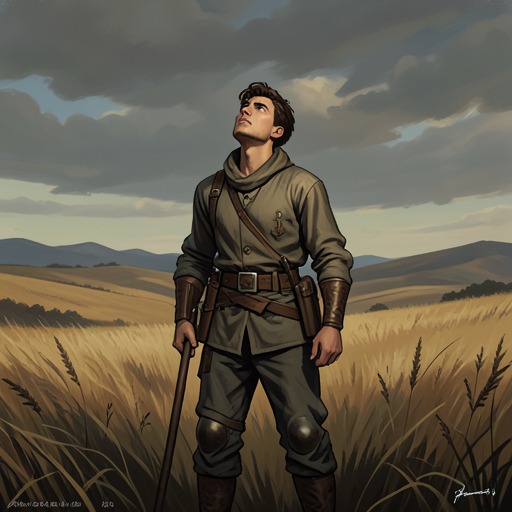
Emeth–Tash devotion
The Last BattleEmeth’s devotion to Tash is the religious conviction that drives him to enter the Stable, even after Rishda Tarkaan orders him to stay out. He believes Rishda’s claim that Tash and Aslan are one, and reasons that if this is true, he must be able to meet Tash inside. The episode exposes the lie at the heart of the supposed alliance between the gods, yet Emeth’s sincere desire to serve Tash is treated differently from the deception that exploits it.
Conviction and the Stable
Emeth first asserts his claim to enter as a fellow Calormene and servant of Tash. Rishda dismisses him as a boy and insists that the Stable concerns the Narnians, not his own people. Emeth answers by taking Rishda’s theology seriously: if their Aslan and his Tash are indeed one, Tash himself is in the Stable, and Emeth has as much reason as anyone to go in. He declares himself willing to die a thousand deaths for a single glimpse of Tash’s face.
Rishda calls the matter beyond Emeth’s understanding, but Emeth presses the contradiction rather than accepting the dismissal. He asks whether Tash and Aslan really are one, and whether the Ape has lied. The Ape affirms the claim; when Emeth demands an oath, Shift reluctantly swears it. Emeth then announces that he is determined to enter. His devotion is therefore not passive allegiance: it becomes a test of the rulers’ public teaching, requiring them either to stand by their claim or reveal its fraudulence.
Entry and Recognition
When Rishda finally allows him through, Emeth walks across the grass between the bonfire and the Stable with his hand on his sword hilt and his head held high. His solemn purpose moves Jill, while Jewel says that, although Emeth is a Calormene, he is worthy of a better god than Tash. Those responses distinguish the young warrior’s sincerity from the political scheme surrounding him.
Emeth opens the Stable door and disappears inside. After a short interval, a figure in Calormene armor comes out, falls, and lies still; Rishda recognizes the face with evident surprise. This outcome overturns Emeth’s expectation that he will find Tash there. The scene exposes the gap between the promise used to direct him toward the Stable and what awaits him beyond its threshold.
Faith, Falsehood, and the Ending
The encounter forms part of the larger reckoning at the Stable, where creatures who look at Aslan with fear and hatred turn away, while those who look at him with love enter through the Door. The narrative presents this division as a judgment on their response to Aslan, not simply on the labels they have been given. Emeth’s conviction that Tash and Aslan are one has been used by Rishda and Shift to support their deception; it cannot make their claim true.
The Stable episode belongs to a final movement from deception and destruction toward a different order of life. Aslan calls the stars home; the sky’s growing blackness is revealed as emptiness left by their departure. Later, when Aslan says, “Now make an end,” the Time-giant extinguishes the sun, bringing the old world to its close. These events make the Stable’s threshold part of a cosmic ending, rather than merely the resolution of a political conspiracy.
Aslan eventually explains that the railway accident was real and that the children and their parents are dead in the world they called the Shadow-Lands. He describes the end not as the end of their story but as the beginning of the Great Story, whose chapters go on forever. In this final frame, Emeth’s devotion remains significant because the narrative separates the goodness of a person’s service from the falsehoods spoken in a god’s name: his belief about the Stable is mistaken, but his earnestness is not presented as equivalent to Rishda’s manipulation.